
.svg)
The Fish Spa in Siem Reap: A Beer-In-Hand Medical Review
.jpg)
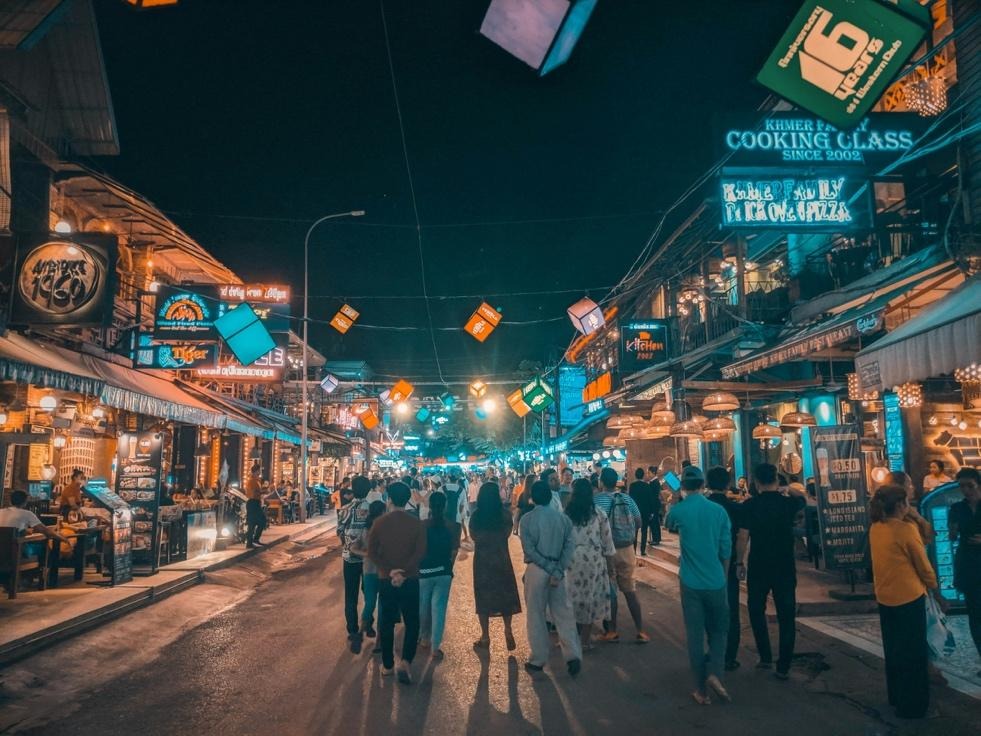
The night market in Siem Reap has a specific kind of pull — tuk-tuks idling at the edges, the smell of grilled lemongrass drifting between stalls, lantern light catching the silk scarves and lacquerware in a way that makes everything look slightly more beautiful than it probably is. You've already eaten. You have a cold Angkor in your hand. And there, between the tailor and the souvenir shop, is a row of illuminated tanks with a hand-painted sign that says Fish Spa — Natural Therapy — Very Healthy! and a price that amounts to about three dollars, including a beer!
You look at the tanks. The tanks, in a manner of speaking, look back.
Meet Your Doctor. It Weighs Four Grams
The fish in question are Garra rufa, a small toothless freshwater species native to Turkey and the Middle East, now deployed at spas from Siem Reap to Seoul with impressive marketing confidence. They're known as "doctor fish," which overstates their qualifications considerably — they have roughly the same medical credentials as a golden retriever, and considerably less useful bedside manner.
What they actually do is nibble softened dead skin cells from the surface of your feet. That's the whole job. They have no teeth — the sensation is somewhere between a mild electric current and being gummed enthusiastically by something very small — which is why almost everyone's first thirty seconds in a fish spa involves involuntary giggling and a brief philosophical reassessment of their life choices.
The medical claims printed on that hand-painted sign — improved circulation, eczema relief, psoriasis treatment — are not well supported by evidence. Some small studies have shown modest short-term improvement in psoriasis symptoms, possibly from the mechanical exfoliation, possibly from the genuinely underrated therapeutic effect of sitting still somewhere beautiful with a beer. The fish are doing something. Whether it rises to the level of therapy depends heavily on your definition of the word.

The Part Where the Physician Weighs In
Here's where the medical picture gets mildly interesting, though not in the direction you might be bracing for.
The infection risk is real and genuinely small. The concern is structural: these tanks are shared between many people, the water isn't chlorinated — chlorine would bother the fish — and that creates a theoretical pathway for skin bacteria to pass between guests. Staphylococcus, Streptococcus, atypical mycobacteria if you want to be thorough about it. There are case reports in the medical literature, a small handful globally, across many years and millions of fish spa visits. From a clinical standpoint, the absolute risk to a healthy traveler with intact skin is low. Not zero, but solidly in the category of things that are worth knowing and not worth worrying about.
The caveats that physicians actually flag: open wounds, active skin infections, compromised immune systems, or recent nail procedures change the calculation meaningfully. If any of those apply, skip it. In clinical practice, fish spas take up almost none of the conversation around Cambodia travel health — there are considerably higher-yield topics to cover, including water, food, dengue, and the optimistic relationship between tuk-tuk drivers and traffic laws.
The Rules, Which Are Reassuringly Short
Intact skin, healthy immune system, no fresh cuts or active infections: you're fine. Rinse your feet with soap and water afterward — not a medical-grade production, just basic hygiene. If you develop unusual redness or irritation in the following week, mention the fish spa when you see a doctor. That is genuinely the complete list.
The rest is just sitting there, cold beer at hand, in one of the more reliably enjoyable cities in Southeast Asia, while small fish attend to your feet with what can only be described as professional dedication. My wife and I did exactly this on a warm night in Siem Reap, and I can report that the fish were thorough, the beer was cold, the market noise was perfect, and nobody required medical attention.
Go. Sit Down. Order Another Beer.
Siem Reap has Angkor Wat — one of the genuine wonders of the world, a place that will rearrange something in how you think about human ambition and the passage of time. It also has the night market, the fish spas, the fifty-cent spring rolls, and the particular quality of an evening that doesn't ask anything of you except to be present in it.
The fish spa is medically unremarkable in the best possible sense. It is not a therapy. It is not a trap. It is three dollars, a cold Angkor, and a very good story for the flight home.
Related articles
.jpg)
.jpg)
.jpg)